CHAPTER 7: COMPANY ANALYSIS – BUSINESS AND GOVERNANCE

NISM Research Analyst Certification Guide

Choose Your Learning Experience

🎬

Watch Overview

Video walkthrough of business and governance analysis

Visual Demo HD Quality
🎧

Audio Commentary

Expert insights on company evaluation

Full Analysis Expert Insights

🎧 Expert Commentary: Company Analysis

Deep dive into business models, competitive positioning, and corporate governance

LEARNING OBJECTIVES:

After studying this chapter, you should know about:

  • Role of company analysis in fundamental research
  • Different kinds of Business Models and sector-specific evaluation parameters
  • Pricing Power and Sustainability of pricing power
  • Critical success factors of a company (competitive advantages and differentiation)
  • SWOT Analysis framework and application
  • Quality of management and governance model evaluation
  • Business risk assessment and mitigation strategies
  • Credit rating history importance and changes over time
  • ESG framework for company analysis
  • Sources of information for comprehensive analysis

πŸ“‘ Chapter Navigation

Business Fundamentals

Strategic Analysis

πŸ“– Complete Course Navigation

Foundation (Ch 1-4)

Analysis (Ch 5-8)

Advanced (Ch 9-13)

Annexures (Ch 14-16)

7.1 Role of Company Analysis in Fundamental Research

Company analysis forms the cornerstone of fundamental research, focusing on company-specific factors that drive performance beyond macroeconomic and industry influences. While external factors affect all companies in an industry, individual company performance depends significantly on internal capabilities and strategies.

Key Company-Specific Questions

Analysts must find comprehensive answers to these critical questions:

  1. Business Understanding: What is the company's business and how does it operate?
  2. Business Model: What is the company's revenue generation mechanism?
  3. Competitive Position: Does the company enjoy competitive advantages?
  4. Strategic Capability: Can the company exploit opportunities and withstand threats?
  5. Management Competency: Is management capable of strategy identification and execution?
  6. Vision and Guidance: Does management provide clear short-term and long-term direction?
  7. Governance Structure: Are proper governance frameworks in place?
  8. Implementation Quality: Are governance structures effectively executed?

Analytical Depth Requirement

Analysts must go beyond superficial answers to find substantive, data-backed insights. While many questions are qualitative, quantitative data should support all findings wherever possible.
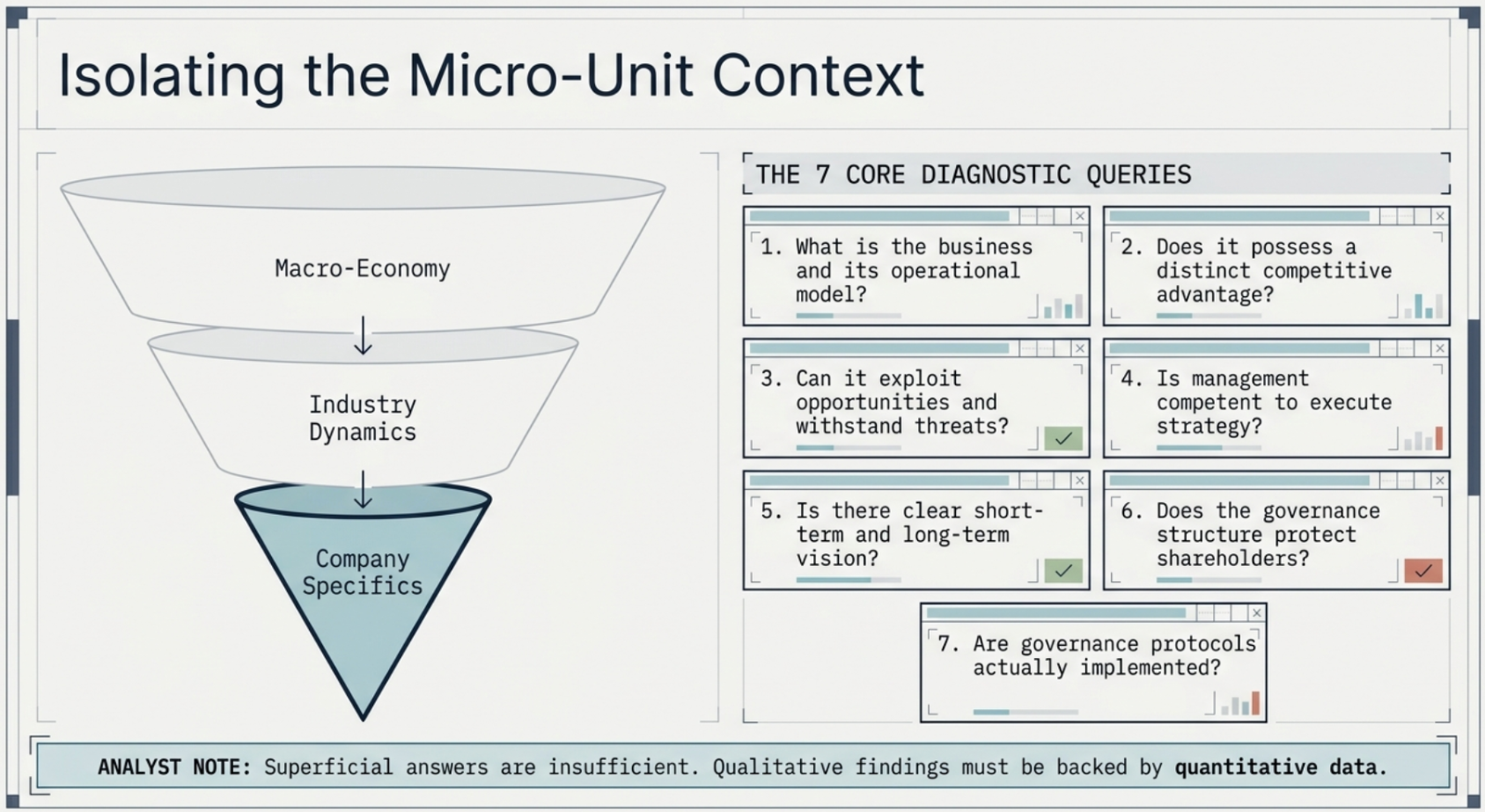
Isolating the Micro-Unit Context: funnel from Macro Economy to Industry Dynamics to Company Specifics, with 7 Core Diagnostic Queries
Company analysis narrows focus from macro conditions and industry dynamics to company-specific factors β€” 7 diagnostic questions guide the analyst from business model clarity through governance quality.

7.2 Understanding Business and Business Models

Equity investing represents part ownership in a business, making thorough business understanding fundamental to investment decisions. The qualitative research foundation requires answering three core questions:

Core Business Understanding Framework

  • Operations: What does the company do and how does it operate?
  • Customer Base: Who are the customers and why do they buy these products/services?
  • Service Delivery: How does the company serve its customers?

Warren Buffett's Investment Philosophy

"Wide diversification is only required when investors do not understand what they are doing." This emphasizes the importance of understanding businesses before investing, rather than diversifying across unknown entities.
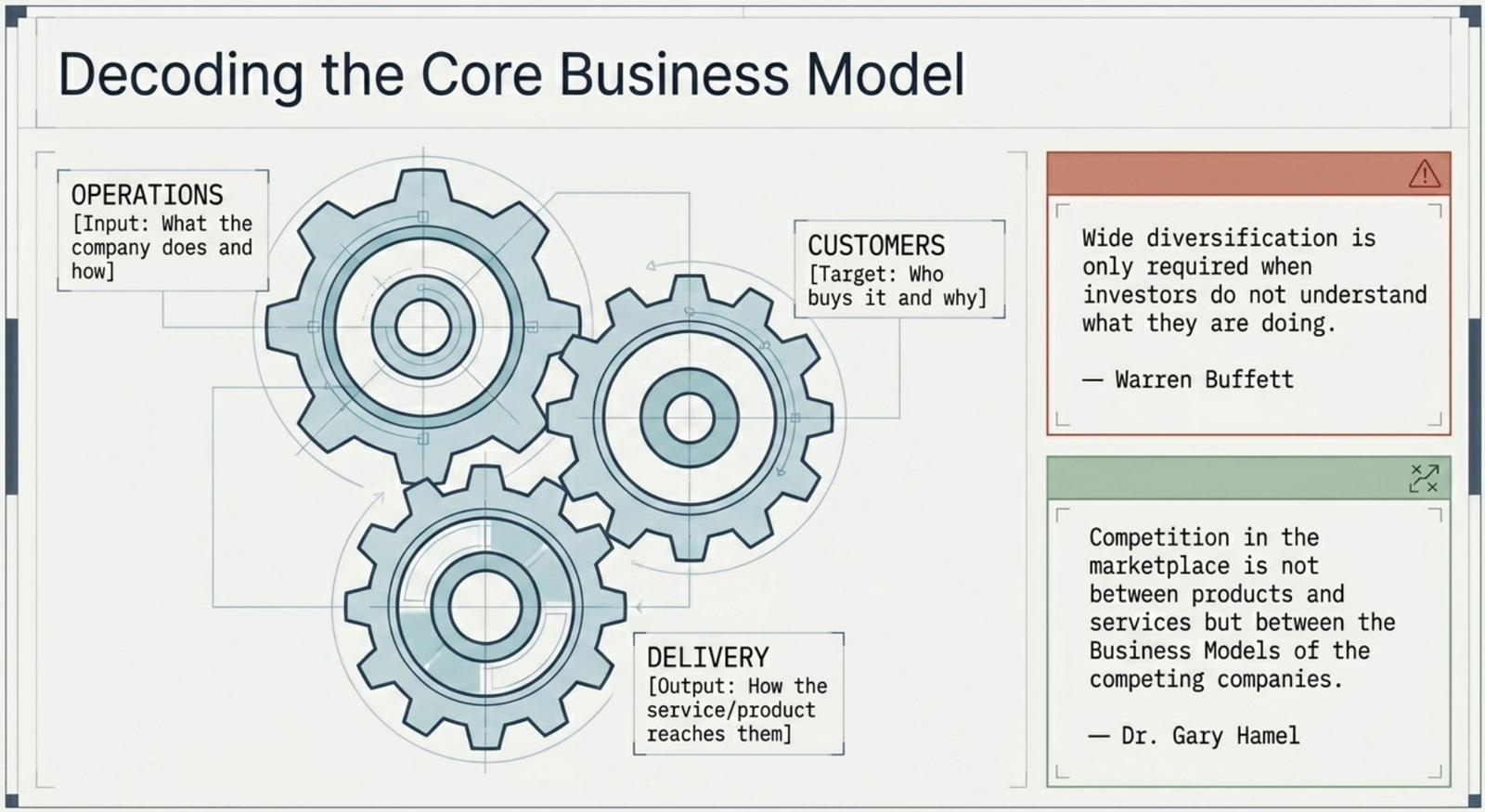
Decoding the Core Business Model: three interlocking gears β€” Operations (what the company does and how), Customers (who buys it and why), Delivery (how the service reaches them) β€” with Buffett and Hamel quotes
Every business model rests on three gears: what the company does (Operations), who it serves (Customers), and how it reaches them (Delivery) β€” competition is ultimately between business models, not just products.

Sector-Specific Evaluation Parameters

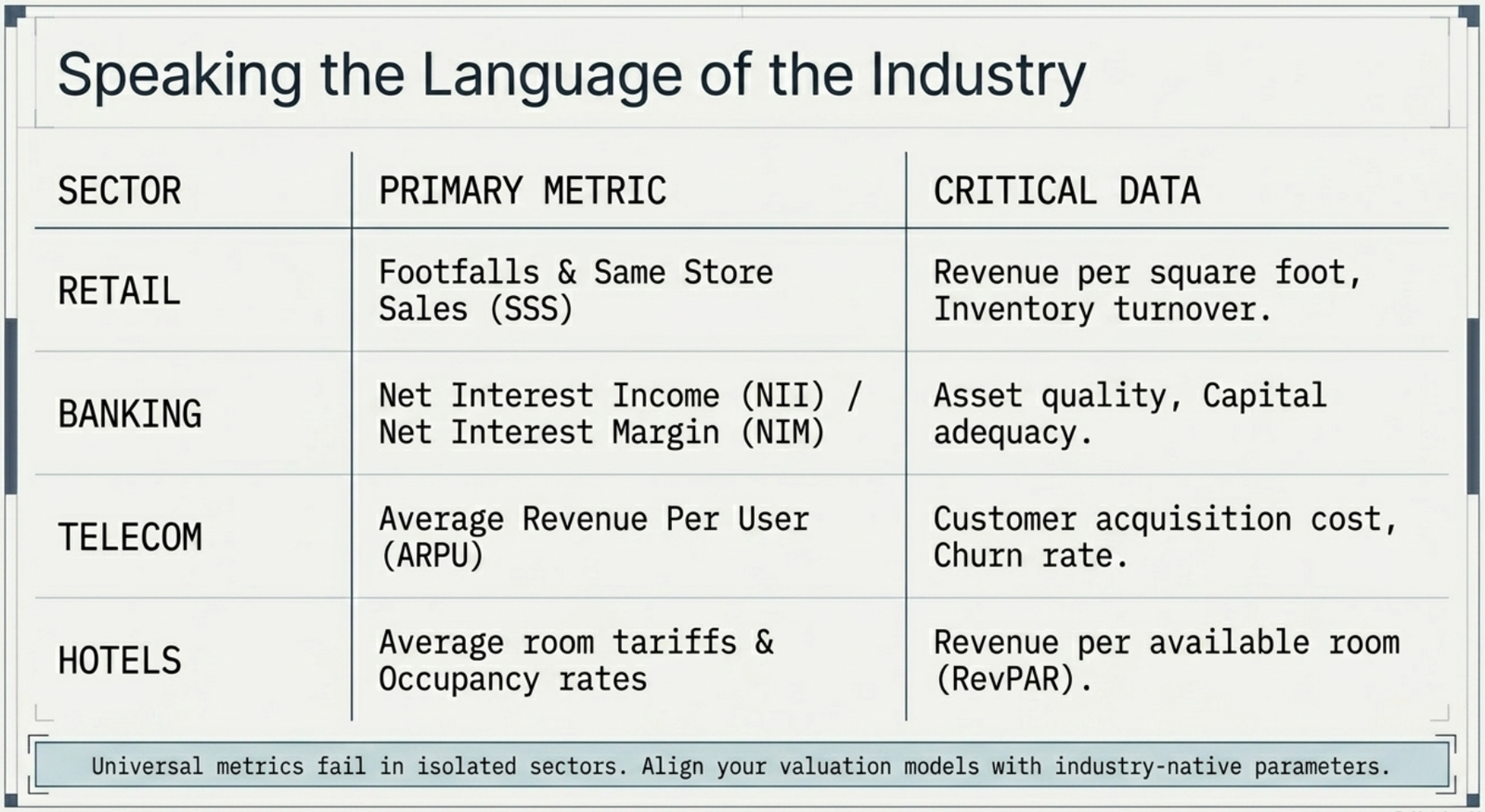
Each sector requires specialized knowledge and unique evaluation metrics:

Sector Key Parameters Critical Metrics
Retail Foot falls, Same Store Sales (SSS) Revenue per square foot, inventory turnover
Banking Net Interest Income (NII), Net Interest Margin (NIM) Asset quality, capital adequacy
Telecom Average Revenue Per User (ARPU) Customer acquisition cost, churn rate
Hotels Average room tariffs, occupancy rates Revenue per available room (RevPAR)
Speaking the Language of the Industry: sector-specific KPI table for Retail (Footfalls and SSS), Banking (NII and NIM), Telecom (ARPU), Hotels (room tariffs and occupancy)
Each sector speaks its own financial language β€” universal metrics alone are insufficient; aligning your valuation model to industry-native parameters is what separates a competent analysis from a superficial one.

Business Model Competition Framework

Dr. Gary Hamel's insight: "Competition in the marketplace is not between products and services but between the Business Models of the competing companies." This highlights the critical importance of understanding how companies create, deliver, and capture value.

7.3 Pricing Power and Sustainability

Pricing power represents a company's ability to independently determine product prices, directly impacting profit margins and growth sustainability. Companies with strong pricing power can pass input cost increases to customers and raise prices during strong demand periods.

Industry-Level Factors

Company-Specific Factors

Pricing Power Drivers

  1. Natural Leadership Position: Industry dominance enabling price-setting capability
  2. Brand Affinity: Strong customer loyalty reducing price sensitivity
  3. Cost Base Advantage: Lower costs enabling competitive pricing without margin pressure
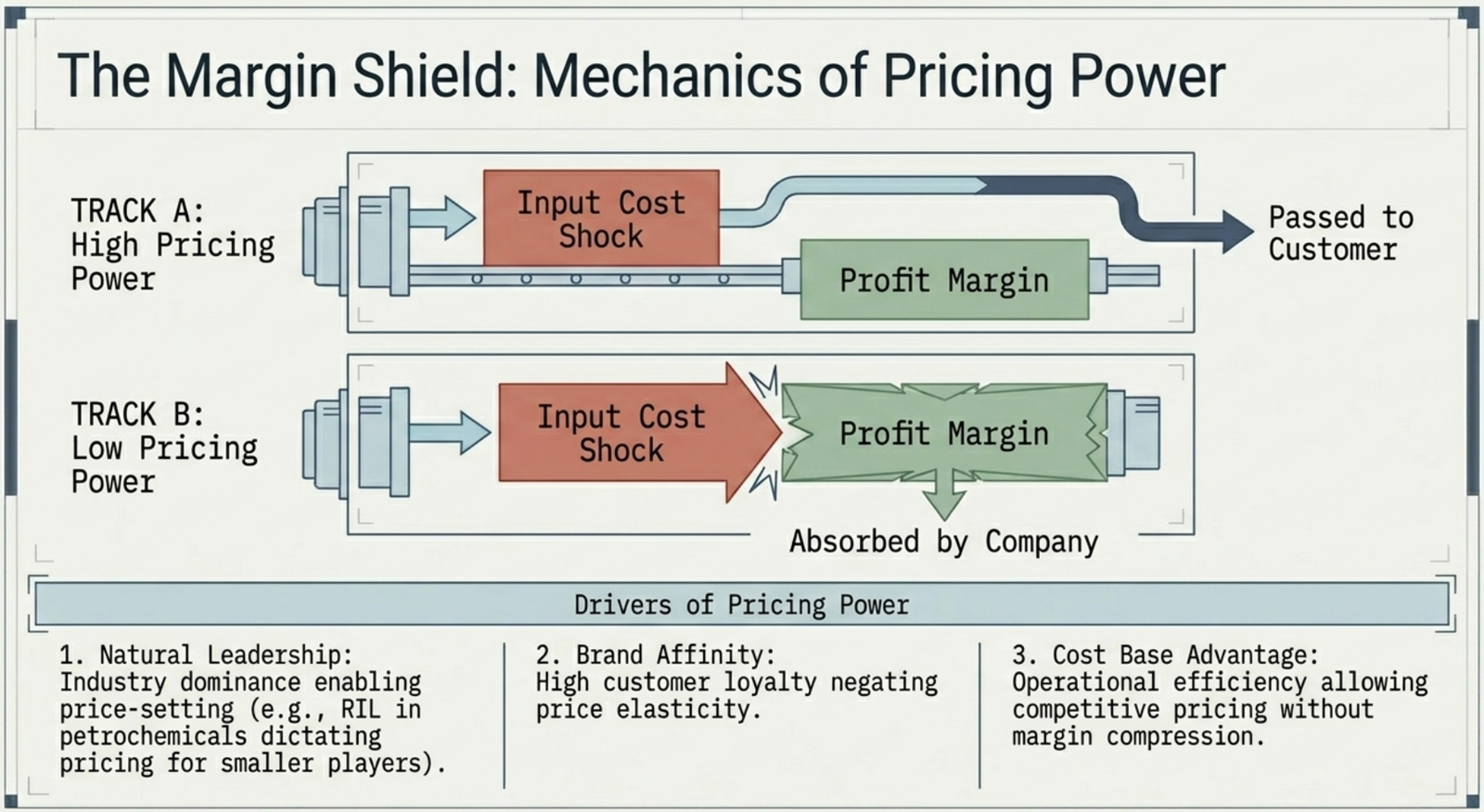
The Margin Shield: Mechanics of Pricing Power β€” Track A (high pricing power) passes input cost shocks to customers; Track B (low pricing power) absorbs shocks into profit margin; three drivers: Natural Leadership, Brand Affinity, Cost Base Advantage
Pricing power is a margin shield β€” companies with natural leadership, brand affinity, or cost base advantage pass input cost inflation to customers; low-pricing-power firms absorb it directly into margins.

Reliance Industries Limited (RIL) Case Study

In petrochemicals, smaller players often price products based on RIL's pricing due to its natural industry leadership position. This demonstrates how market position can create independent pricing capability.

7.4 Competitive Advantages and Differentiation

Industry performance varies significantly among players, making competitive positioning analysis crucial for predicting individual company performance relative to peers.

Three Categories of Differentiation

Product Differentiation

  • Superior product quality
  • Enhanced functionality
  • Strong R&D capability
  • Innovation culture

Competitive Pricing

  • Operational efficiency
  • Low-cost advantage
  • Sustainable cost leadership
  • Value-for-money proposition

Execution Excellence

Superior execution capabilities include:

  • Customer Communication: Enhanced customer relationship management
  • Sales Strategy: Focused and effective sales approaches
  • Operational Excellence: Superior implementation capabilities
  • Management Track Record: Historical performance validation
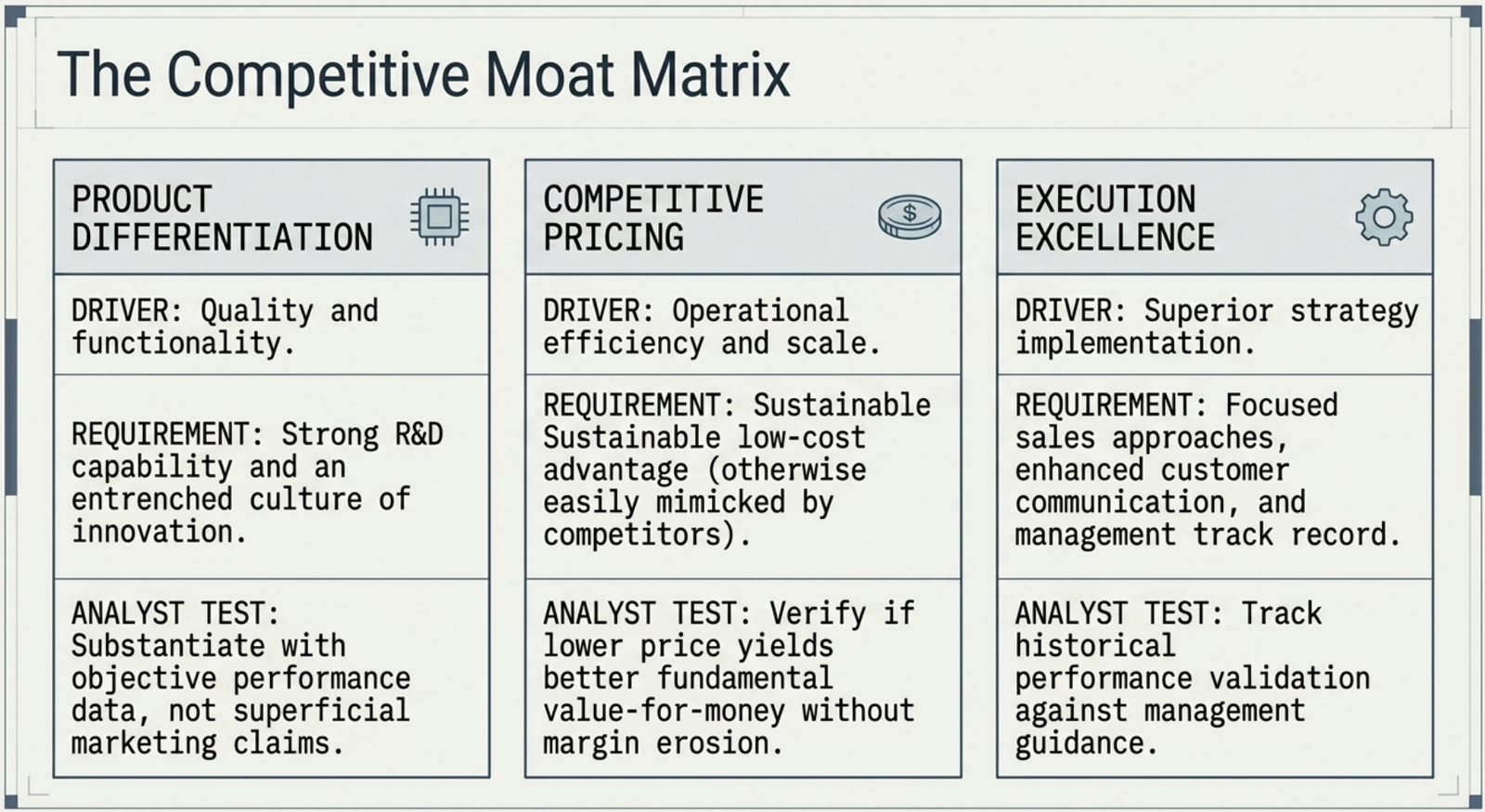
The Competitive Moat Matrix: three columns β€” Product Differentiation (driver: quality and functionality), Competitive Pricing (driver: operational efficiency and scale), Execution Excellence (driver: superior strategy implementation) β€” each with requirement and analyst test
Sustainable competitive advantage stems from one of three moats: product differentiation (R&D and innovation), competitive pricing (low-cost base), or execution excellence (superior implementation) β€” analyst tests verify each claim with objective performance data.

Analysis Best Practices

Analysts must rely on substantive data rather than superficial marketing claims. Competitive advantage assessment requires thorough comparison of actual performance metrics, not promotional materials.

7.5 SWOT Analysis Framework

SWOT analysis provides a structured framework for evaluating company fundamentals in the context of external environmental changes. This analysis helps assess growth potential and risk tolerance.

COVID-19 Pandemic Impact

The pandemic created major business disruption through lockdowns. Companies with strong financial positions survived the challenge, while those with weak finances faced severe vulnerability. This demonstrates how external threats interact with internal strengths and weaknesses.

SWOT Framework Application

Two Analytical Approaches

  1. Internal-First Approach: Identify strengths/weaknesses, then assess opportunity exploitation and threat vulnerability
  2. External-First Approach: Identify opportunities/threats, then evaluate company capabilities and vulnerabilities (recommended for equity analysts)

Strengths (Internal Positives)

  • Strong financial position
  • Valuable intellectual properties
  • Low customer concentration
  • Low cost base or high margins
  • Parent/government support
  • Strong execution track record

Weaknesses (Internal Negatives)

  • Weak financial position
  • High fixed costs
  • Low margins vulnerable to downturns
  • High customer concentration
  • Significant legal cases
  • Limited strategic experience

Opportunities (External Positives)

  • Growth Catalysts: New technologies, market shifts
  • Business Expansion: Regulatory changes, new markets
  • Geographic Growth: Market access improvements
  • Consolidation: Market disruption creating acquisition opportunities

Threats (External Negatives)

  • Economic Recession: Demand decline, financial stress
  • Regulatory Headwinds: Policy changes, compliance costs
  • Technology Disruption: Industry transformation risks
  • Increased Competition: Deregulation, new entrants
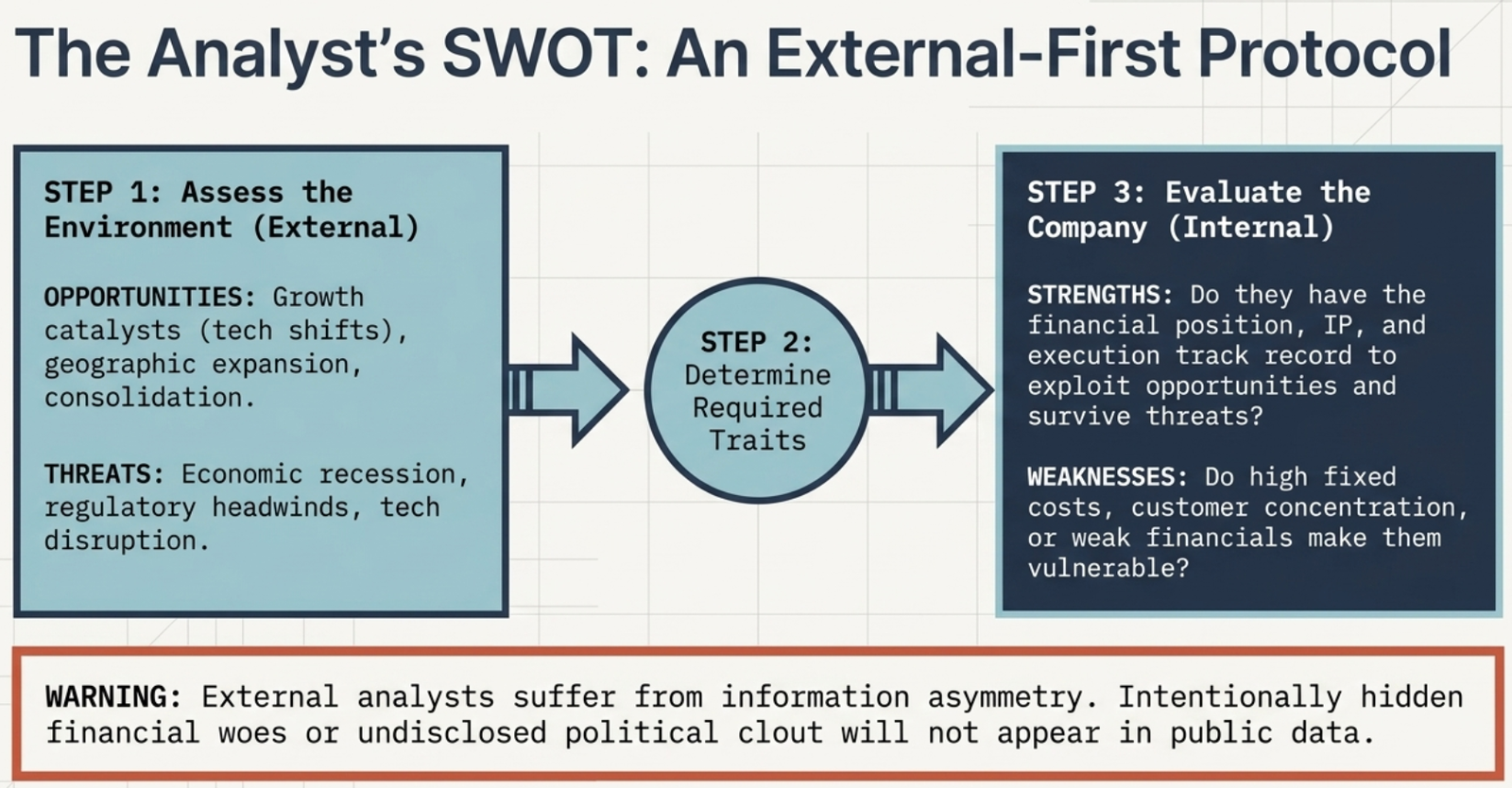
The Analyst's SWOT External-First Protocol: Step 1 Assess Environment (Opportunities: growth catalysts, geographic expansion; Threats: recession, regulation, tech disruption), Step 2 Determine Required Traits, Step 3 Evaluate Company (Strengths and Weaknesses)
The recommended SWOT sequence for equity analysts is external-first: scan for opportunities and threats in the environment, determine what capabilities are required, then audit whether the company actually possesses them β€” external analysts suffer information asymmetry on hidden financial issues.
Analysis Limitation: External analysts may not identify all internal strengths and weaknesses due to information asymmetry. Companies may not disclose political influence or may conceal financial issues through creative accounting.

7.6 Quality of Management and Governance Structure

The separation of ownership and management in corporations creates agency risk, making management and governance evaluation critical for investment decisions.

Agency Risk

Shareholders rely on management to act in company and shareholder interests, but risk exists that management may pursue personal interests or lack capability for effective organizational leadership.
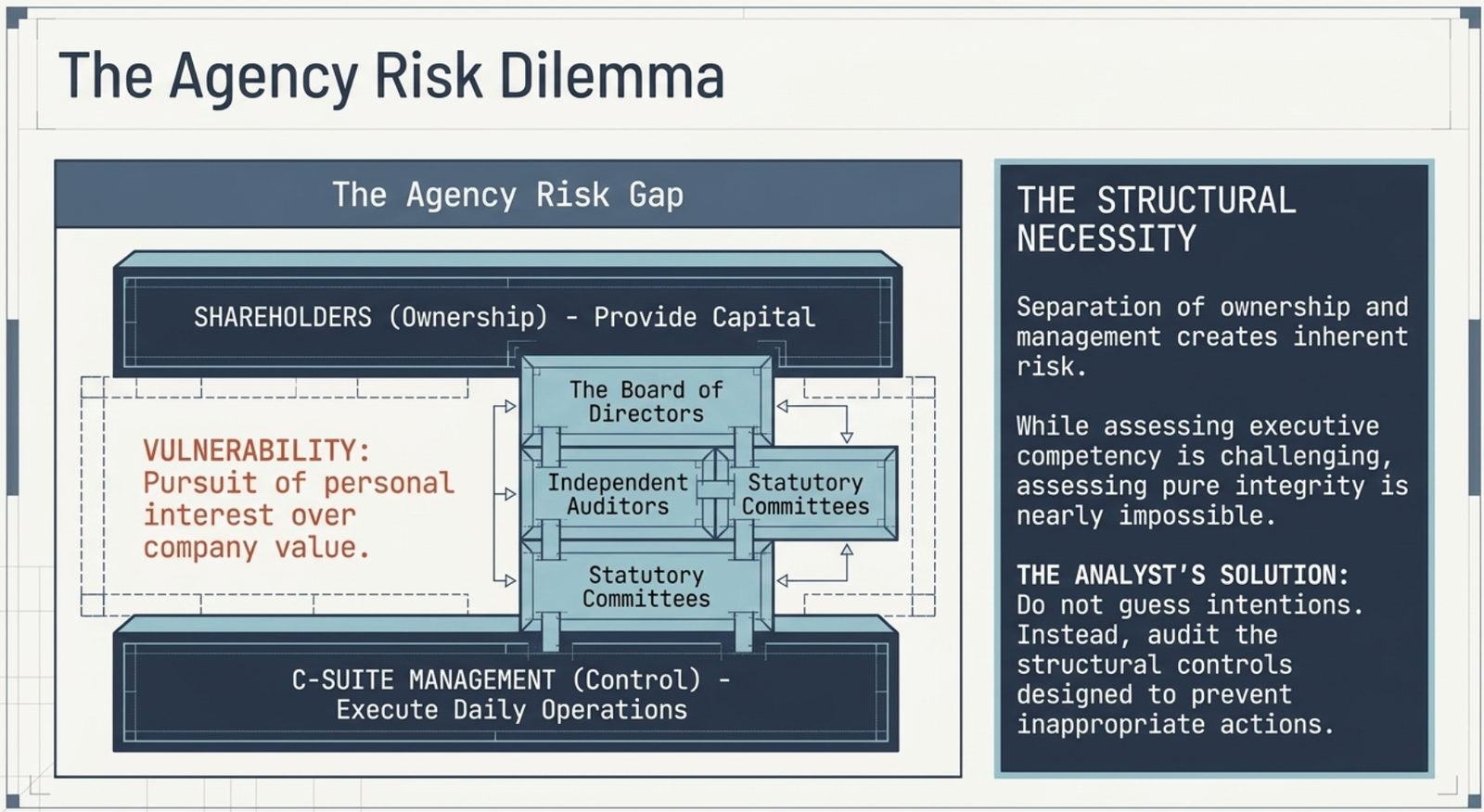
The Agency Risk Dilemma: shareholders provide capital at top, C-suite management controls daily operations at bottom, with Board of Directors, Independent Auditors and Statutory Committees as structural guardrails against the agency risk gap
The ownership-control split is the root of agency risk β€” pure integrity is nearly impossible to assess from outside, so analysts must audit the structural controls (board composition, audit committees, compliance record) designed to prevent management misalignment.

7.6.1 Management Competency Evaluation

Assessing top management (CEO, CFO, COO, C-level officers) presents challenges due to their diverse experience and expertise. Analysts should evaluate multiple dimensions:

Management Assessment Framework

  1. Educational Qualifications: Relevant discipline expertise (limited predictive value)
  2. Experience Duration: Years of experience facing business challenges
  3. Track Record Analysis: Performance in previous senior roles
  4. Company Tenure Performance: Results during current company association
  5. Strategic Vision: Long-term goals and strategic direction clarity
  6. Strategy-Specific Experience: Competency in executing current strategy
  7. Guidance Reliability: Consistency in meeting performance guidance
  8. Regulatory Compliance: Timely compliance with all requirements
  9. Decision Delegation: Broad-based vs. concentrated decision-making
  10. Succession Planning: Management continuity preparation
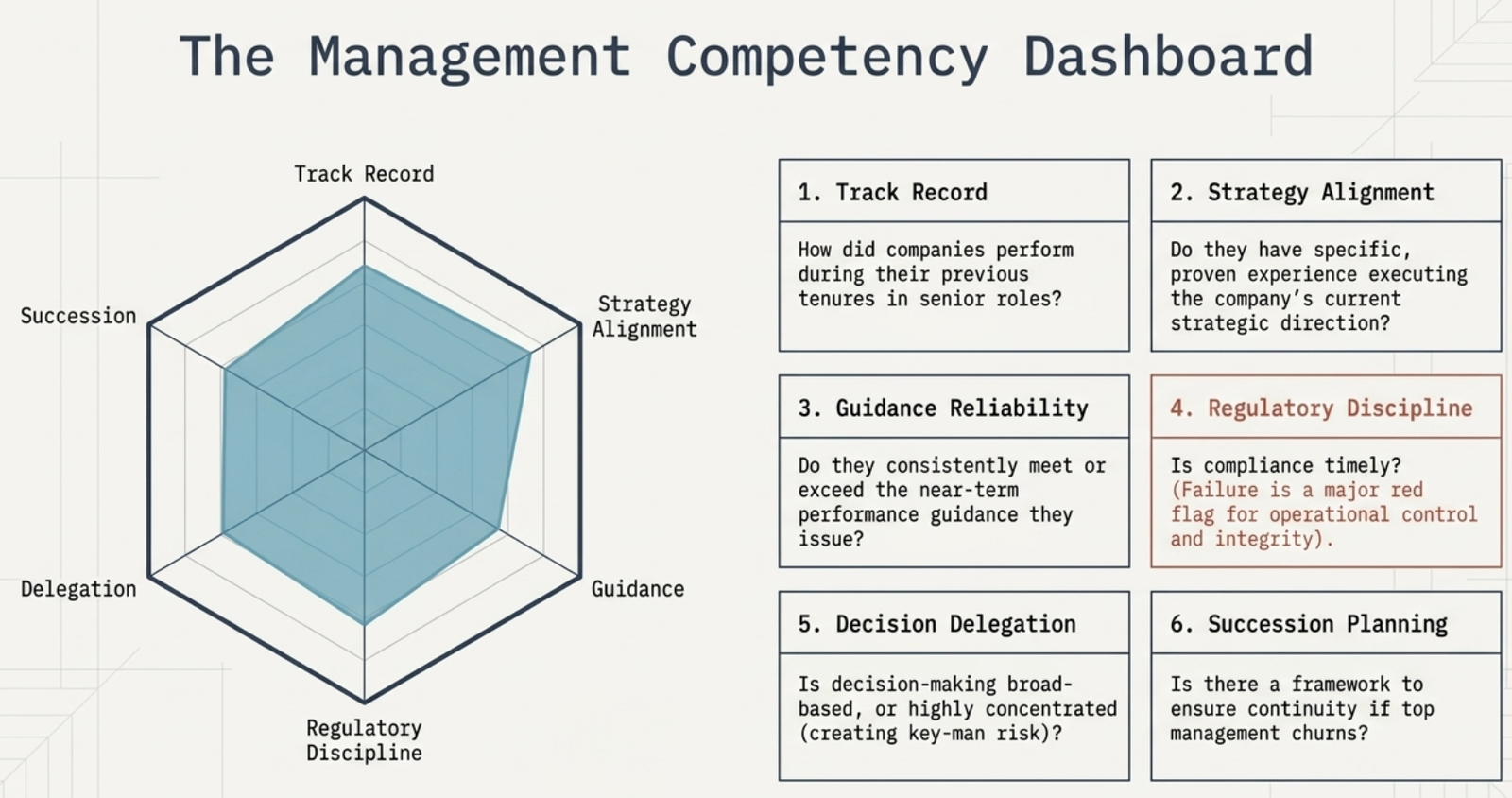
The Management Competency Dashboard: radar chart of six dimensions β€” Track Record, Strategy Alignment, Guidance Reliability, Regulatory Discipline, Decision Delegation, Succession Planning β€” with evaluation questions for each
Management competency spans six auditable dimensions β€” while pure integrity cannot be measured directly, track record, guidance reliability, regulatory discipline, and succession planning frameworks are objectively verifiable from public disclosures.

7.6.2 Corporate Governance Evaluation

Corporate governance encompasses rules, processes, and procedures ensuring stakeholder interests protection, with regulatory focus on investor protection, especially minority shareholders.

SEBI Governance Standards

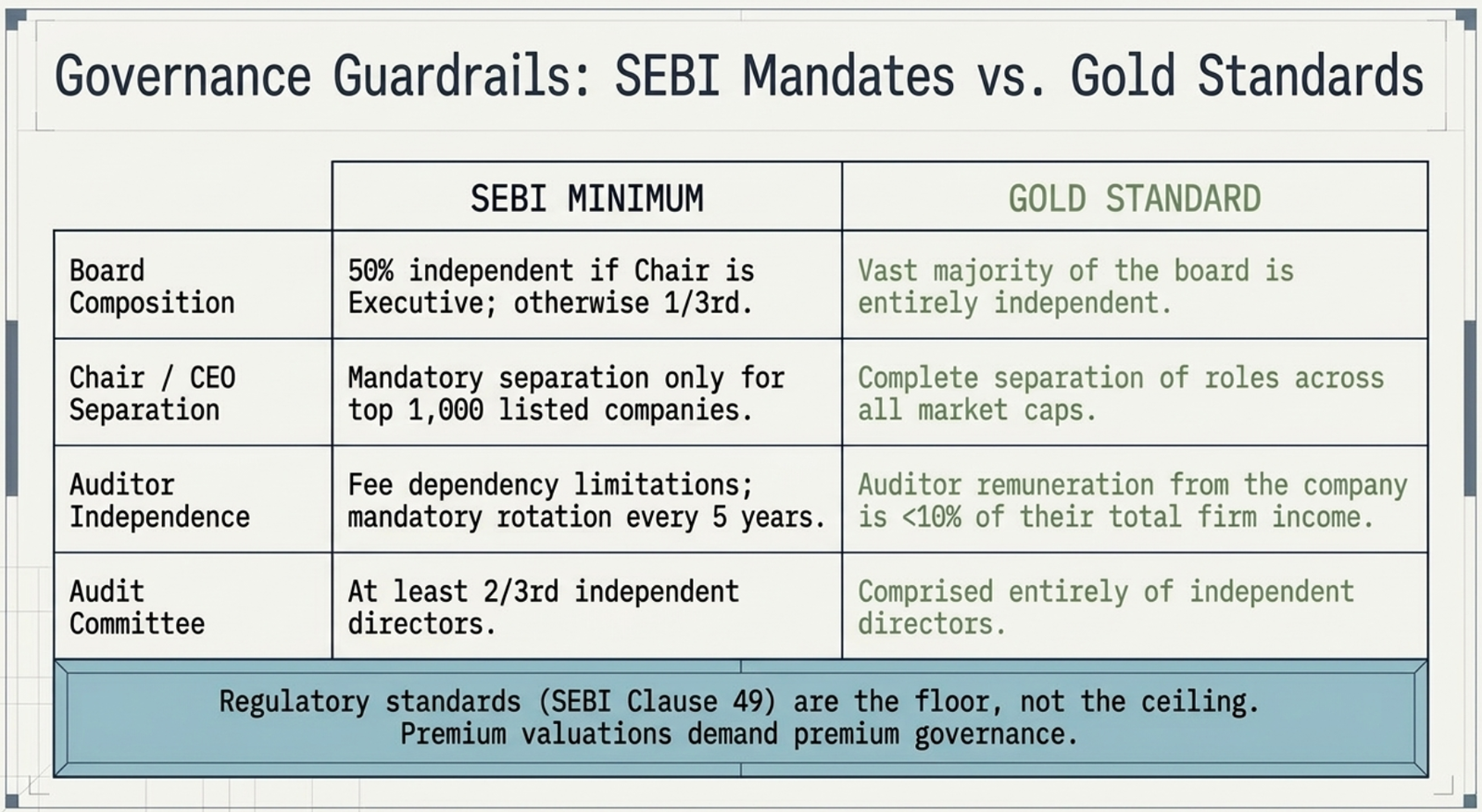
SEBI's Clause 49 sets minimum corporate governance standards. Companies may adopt higher standards for stronger governance.

Governance Assessment Criteria

Governance Aspect Best Practice SEBI Requirement
Board Composition Majority independent directors 50% if executive chairman, otherwise 1/3rd
Chairman-CEO Separation Complete separation Mandatory for top 1,000 companies
Independent Director Nomination Independent directors only Nomination committee requirement
Auditor Independence <10% of auditor's total income Fee dependency limitations
Auditor Rotation Every 5 years Mandatory rotation
Audit Committee Entirely independent directors At least 2/3rd independent
Governance Guardrails β€” SEBI Mandates vs Gold Standards: Board Composition (50% independent if executive chair vs vast majority independent), Chair/CEO Separation (mandatory for top 1,000 vs all market caps), Auditor Independence (fee limits vs <10% of firm income), Audit Committee (2/3rd independent vs entirely independent)
SEBI Clause 49 sets the regulatory floor, not the ceiling β€” premium-quality governance (fully independent board, complete Chair/CEO separation, auditor income below 10% of firm revenue) commands premium valuations from sophisticated investors.

7.6.3 Promoter Holdings Analysis

The promoter concept, unique to India, significantly impacts company control and minority shareholder interests.

Promoter Impact Assessment

Positive Aspects:

  • Higher management control ensuring shareholder interest alignment
  • Long-term strategic focus

Risk Factors:

  • Potential for related party transactions benefiting promoters
  • Minority shareholder interest subordination

Share Pledging Risks

High promoter share pledging can create market risk through forced liquidation during price declines, creating additional downward pressure on share prices.
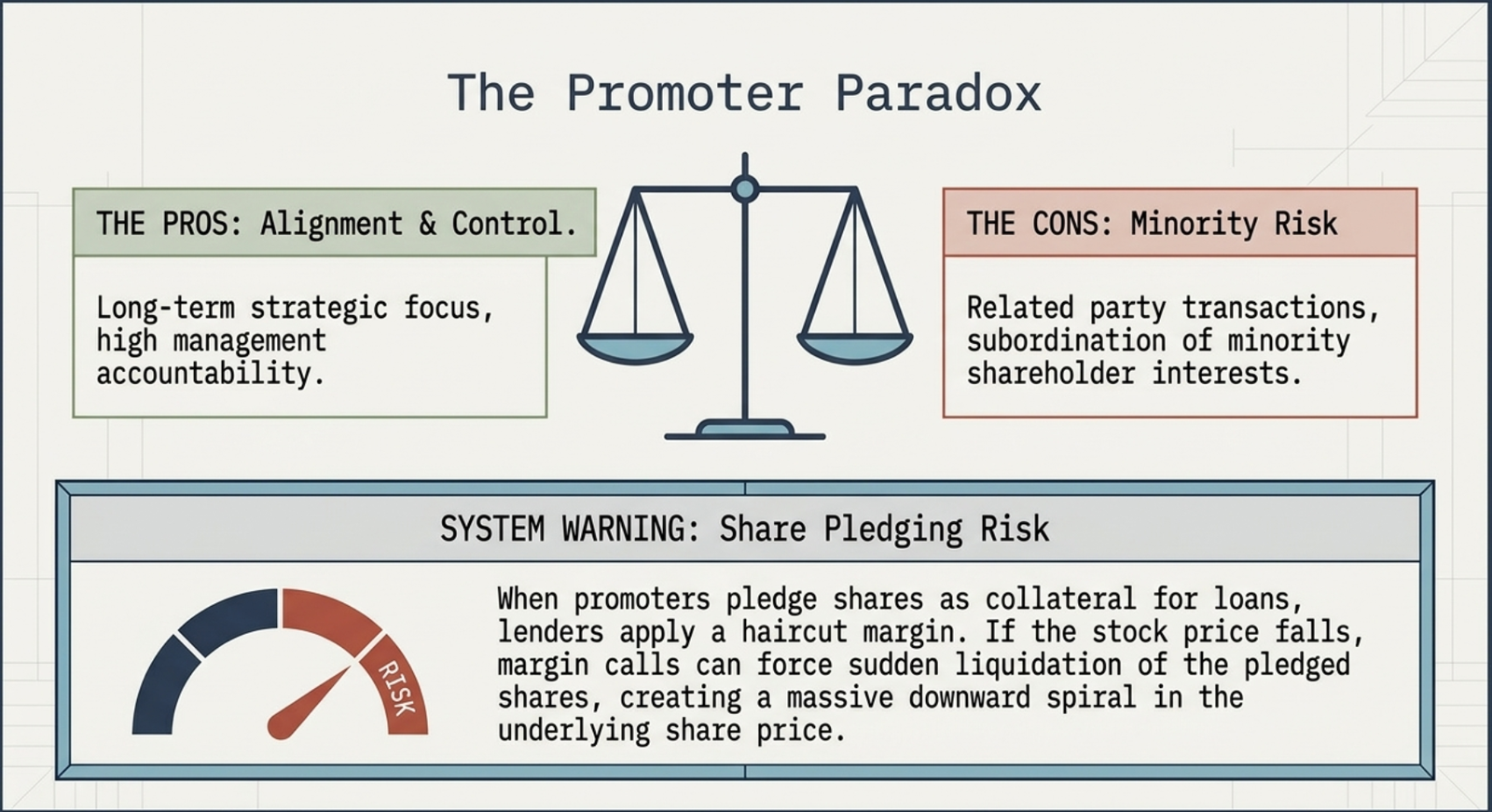
The Promoter Paradox: balance scale weighing Pros (long-term strategic focus, high management accountability) against Cons (related party transactions, subordination of minority shareholder interests), with Share Pledging Risk system warning
The promoter structure is a double-edged sword β€” high ownership aligns management with shareholders long-term, but related party transactions and pledged shares can rapidly destroy minority shareholder value through forced margin-call liquidations.

7.7 Business Risk Assessment

Entrepreneurs naturally focus on opportunities while potentially understating risks. Comprehensive risk assessment is essential for investment evaluation.

Risk Awareness Examples

Currency Risk: International borrowing at low rates appears attractive until currency risk consideration transforms the entire risk-return proposition.

Execution Risk: Rupert Murdoch failed three times before creating the Star Empire; Steve Jobs was removed from Apple before returning successfully.

Risk Assessment Framework

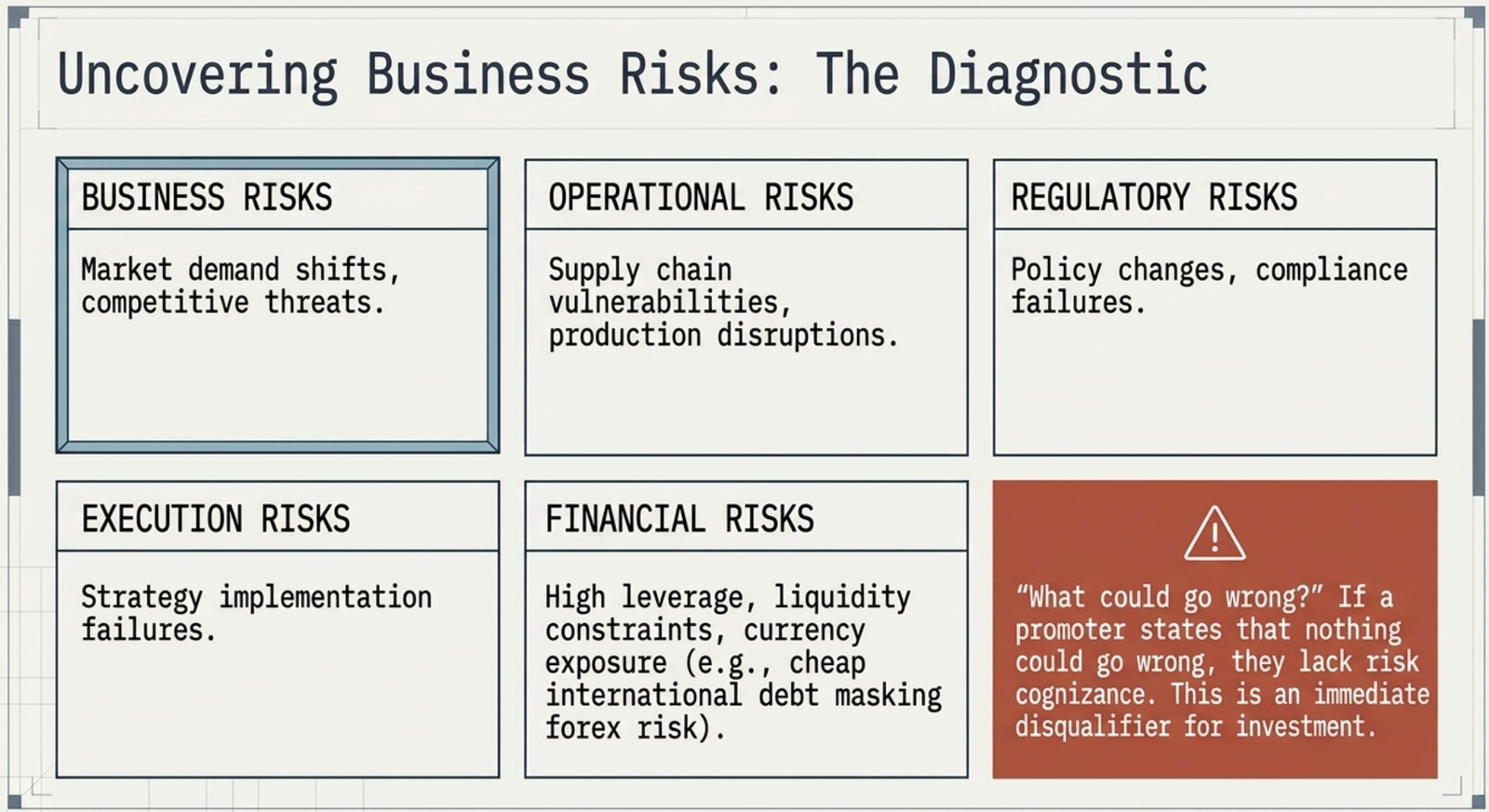
Analysts should continuously ask: "What could go wrong in the business?"

Red Flag: Promoters claiming "nothing could go wrong" indicate insufficient risk awareness and should be avoided.

Business Risk Categories

Uncovering Business Risks β€” The Diagnostic: five risk category grid (Business Risks: market demand shifts; Operational Risks: supply chain disruptions; Regulatory Risks: compliance failures; Execution Risks: strategy implementation failures; Financial Risks: high leverage and currency exposure) with red-flag warning about promoters claiming nothing can go wrong
Systematic risk auditing covers five categories β€” a promoter who claims nothing could go wrong is an immediate investment disqualifier, signalling a dangerous absence of risk cognizance that will eventually manifest in poor outcomes.

7.8 Credit Rating History Analysis

Credit ratings assess borrower ability to service debt obligations, providing insights relevant to equity investors since equity returns depend on debt service priority.

Credit Rating Relevance for Equity Analysis

  • Financial Risk Assessment: Credit ratings indicate financial risk levels affecting return expectations
  • Management Responsiveness: Historical rating changes reveal management response to external feedback
  • Risk Evolution Tracking: Rating progression shows how company addresses identified concerns
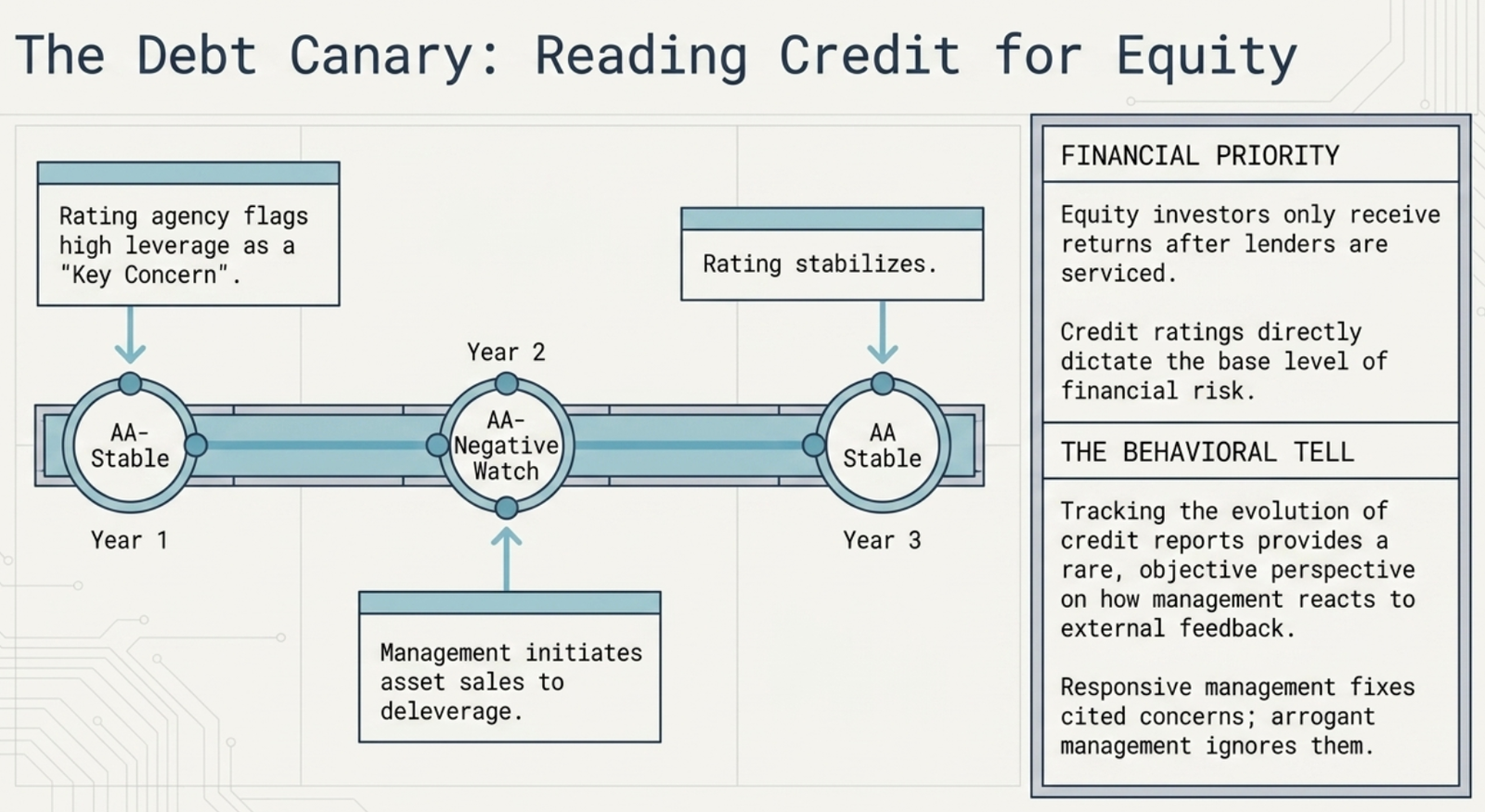
Credit rating reports specify rating factors and key concerns. Companies addressing these concerns demonstrate responsive management, while persistent issues indicate management limitations.
The Debt Canary β€” Reading Credit for Equity: rating evolution timeline from AA-Stable to AA-Negative Watch back to AA-Stable as management deleverages, with Financial Priority (equity is residual) and Behavioral Tell (management reaction to feedback) annotations
Credit rating history is a behavioral tell for equity analysts β€” equity investors receive returns only after debt is serviced, so tracking how management responds to rating agency concerns reveals both financial risk level and the quality of management responsiveness.

7.9 ESG Framework for Company Analysis

Environmental, Social, and Governance (ESG) criteria have evolved from niche "impact" investing to mainstream investment frameworks providing both ethical and commercial value.

ESG Evaluation Criteria

  1. Environmental Impact: Carbon emissions, pollution contribution, resource usage
  2. Social Development: Human rights, gender equality, community contribution
  3. Governance Standards: Corporate governance practices and transparency

ESG Commercial Benefits

ESG Factor Financial Advantage Business Impact
Environmental Focus Reduced regulatory disruption Lower compliance costs, operational efficiency
Social Initiatives Positive brand recall Enhanced employee recruitment, customer attraction
Sustainable Production Resource cost reduction Lower power and water consumption costs
Strong Governance Reduced cost of capital Lower risk perception among investors

SEBI ESG Initiative

SEBI mandates top 1,000 listed companies to make ESG disclosures per Business Responsibility and Sustainability Report (BRSR) parameters from FY2023, enhancing transparency for ESG analysis.
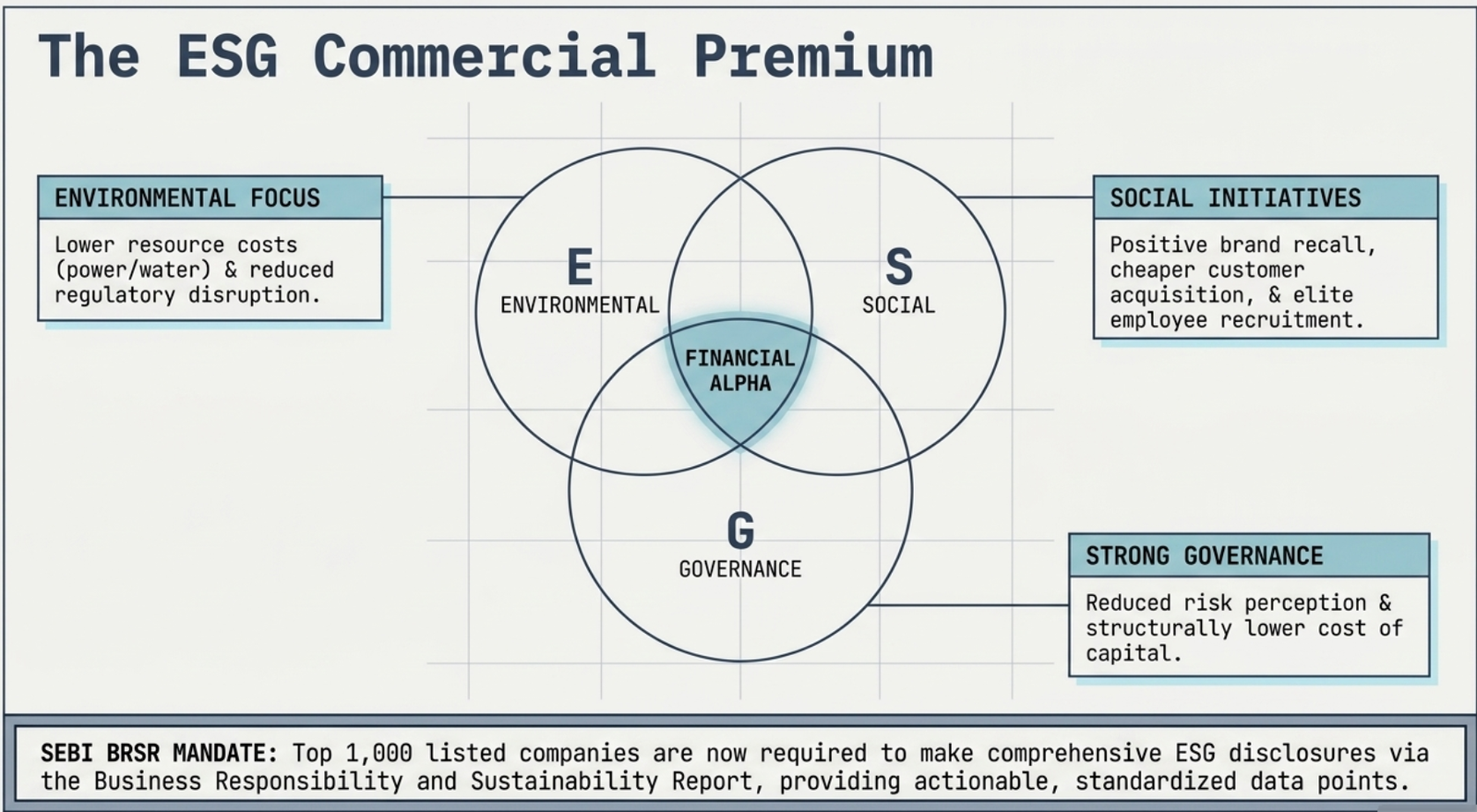
The ESG Commercial Premium: Venn diagram of Environmental (lower resource costs and reduced regulatory disruption), Social (positive brand recall and elite recruitment) and Governance (reduced risk perception and lower cost of capital) factors overlapping to create Financial Alpha, with SEBI BRSR mandate note
ESG delivers commercial alpha, not just ethical optics β€” environmental efficiency lowers costs, social initiatives build brand equity, and strong governance reduces the cost of capital; SEBI's BRSR mandate now makes ESG data structured and comparable across India's top 1,000 listed companies.

7.10 Information Sources for Analysis

Comprehensive company analysis requires diverse information sources, both public and proprietary, to develop complete understanding.

Primary Information Sources

Essential Information Sources

  • Annual/Quarterly Reports: Most reliable, consistent information source
  • Conference Call Transcripts: Management insights and strategic direction
  • Investor Presentations: Strategic updates and performance metrics
  • Management Interviews: Leadership perspectives and vision
  • Company Website: Official information and updates
  • MCA Website: Legal and compliance information
  • Credit Rating Reports: Independent risk assessment
  • Media Reports: Market perspectives and industry insights
  • Competitor Analysis: Comparative positioning and benchmarking
  • Stakeholder Discussions: Suppliers, vendors, customers, competitors
  • BRSR Reports: ESG disclosure and sustainability metrics
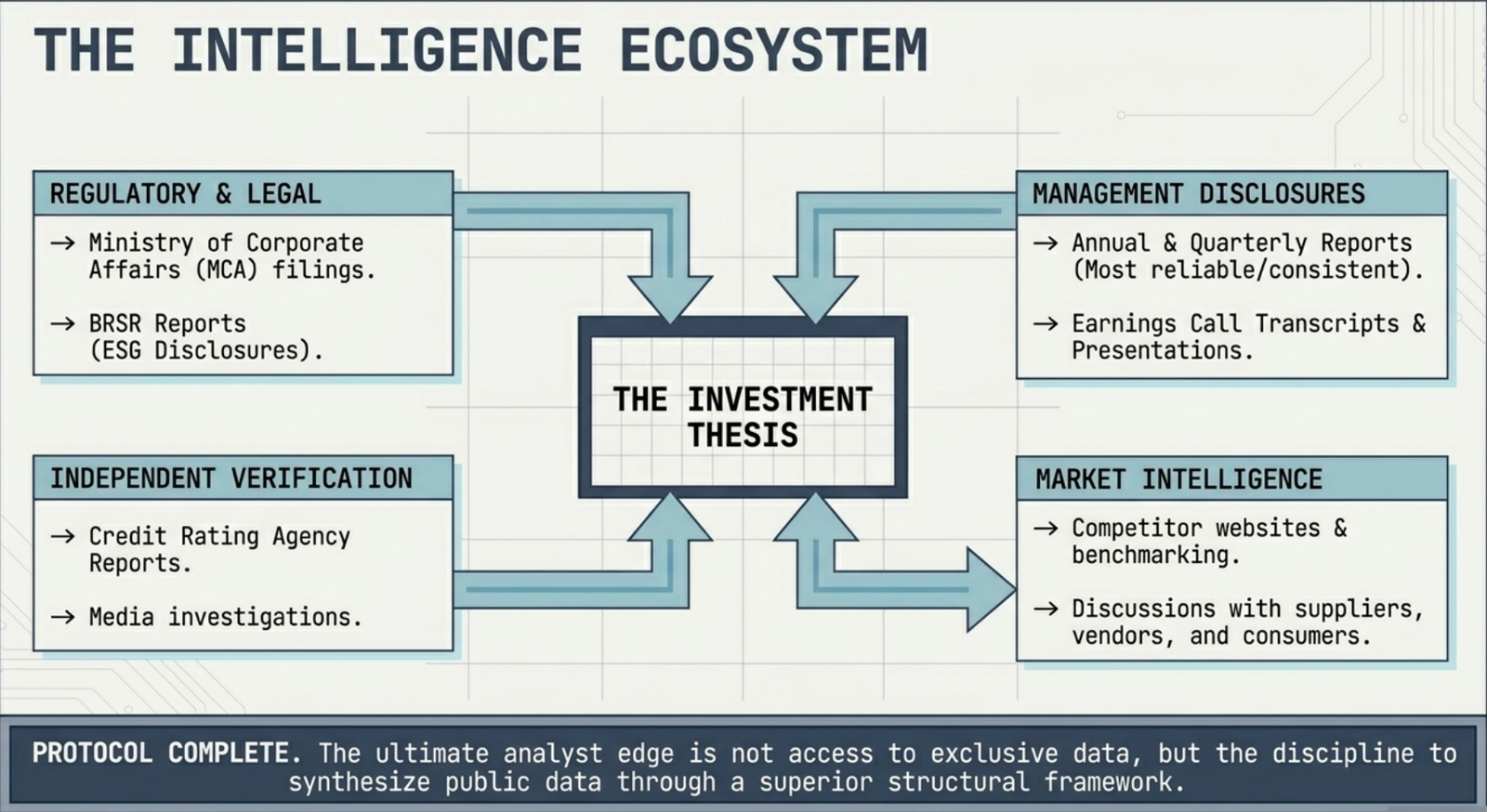
The Intelligence Ecosystem: four source quadrants feeding The Investment Thesis β€” Regulatory and Legal (MCA filings, BRSR reports), Management Disclosures (annual and quarterly reports, earnings call transcripts), Independent Verification (credit rating agency reports, media investigations), Market Intelligence (competitor benchmarking, supplier and customer discussions)
The analyst's edge lies not in exclusive data access but in disciplined synthesis β€” annual reports, credit rating reports, MCA filings, competitor benchmarking, and stakeholder conversations together build an investment thesis no single source can provide.

πŸƒ Flashcards

65 cards β€” click any card to reveal the answer

Why is a company considered a 'micro unit' in fundamental research?
Its fortunes are influenced by the broader economy and specific industry factors.
tap to reveal
What must an analyst understand at the very beginning to define a company's industry?
The company's core business.
tap to reveal
Why should an analyst verify qualitative management claims with data?
To ensure findings are substantiated rather than based on superficial answers.
tap to reveal
According to Warren Buffett, when is wide diversification required?
When investors do not understand what they are doing.
tap to reveal
Which two parameters are critical for evaluating the retail sector?
Footfalls and same store sales (SSS).
tap to reveal
What are the primary metrics used to evaluate the banking sector?
Net Interest Income (NII) and Net Interest Margin (NIM).
tap to reveal
Which evaluation parameter is specific to the telecom industry?
Average Revenue Per User (ARPU).
tap to reveal
Which evaluation parameter is specific to the hotel industry?
Average room tariffs and occupancy rates.
tap to reveal
According to Dr. Garry Hamel, what is the true nature of marketplace competition?
Competition is between business models rather than products and services.
tap to reveal
Term: Pricing Power
Definition: A company's ability to independently determine and charge the price of its products.
tap to reveal
How does strong pricing power help a company manage rising input costs?
It allows the company to pass the escalation in costs to its customers.
tap to reveal
Which industry-level factor measures customer sensitivity to price changes?
Price elasticity of the product.
tap to reveal
How does a low-cost base provide a company with pricing power?
It allows the company to keep prices low while remaining financially viable compared to high-cost competitors.
tap to reveal
What is an example of 'natural leadership' pricing power in the petrochemical industry?
Smaller players setting prices based on those established by Reliance Industries Limited (RIL).
tap to reveal
What are the three main areas where a company can differentiate itself from competitors?
Product features, competitive pricing, and better execution.
tap to reveal
What internal capabilities are required for a company to lead in product differentiation?
A strong research and development (R&D) team and a culture of innovation.
tap to reveal
Under what condition is competing through low prices sustainable?
Only if the company possesses a low-cost advantage.
tap to reveal
How can an analyst study a company's execution capabilities?
By examining the past track record of the company and its management.
tap to reveal
Which SWOT analysis components are considered internal to the company?
Strengths and Weaknesses.
tap to reveal
Which SWOT analysis components emanate from external conditions?
Opportunities and Threats.
tap to reveal
Which SWOT sequence is most suitable for an external equity analyst?
Identify opportunities and threats first, then identify strengths and weaknesses.
tap to reveal
How does a strong financial position act as a Strength in SWOT?
It allows a company to exploit opportunities and withstand external threats.
tap to reveal
Why is high customer concentration considered a Weakness rather than a Threat?
It is an internal issue related to the company's client structure.
tap to reveal
What is an example of a growth inflection point creating an Opportunity?
New battery technology accelerating growth in the electric vehicle segment.
tap to reveal
How can adverse market conditions like a competitor's bankruptcy create an Opportunity?
It allows remaining players to consolidate the market and increase their share.
tap to reveal
What is a major Threat currently facing the BPO industry due to technological disruption?
Artificial Intelligence performing repetitive tasks.
tap to reveal
Term: Agency Risk
Definition: The risk that management may pursue personal interests at the cost of shareholders.
tap to reveal
Why is it difficult for analysts to evaluate management integrity directly?
Integrity is hard to measure without evidence, so analysts focus on governance structures instead.
tap to reveal
How does meeting near-term performance guidance consistently reflect on management?
It indicates the management has better control over the business.
tap to reveal
Why is failure to meet regulatory compliance considered a 'red flag'?
It suggests management is not in control of affairs and raises integrity concerns.
tap to reveal
Term: Keyman Risk
Definition: The risk that decision-making is so highly concentrated that management churn derails the company.
tap to reveal
Which Indian regulation sets the minimum standards for corporate governance?
SEBI's Clause 49 of the listing agreement.
tap to reveal
What is the SEBI board composition requirement if the chairman is an executive director?
At least 50% of the board must consist of independent directors.
tap to reveal
What is the SEBI board composition requirement if the chairman is NOT an executive director?
At least 1/3rd of the board must consist of independent directors.
tap to reveal
For which companies is the separation of Chairman and CEO roles mandated by SEBI?
The top 1,000 listed companies.
tap to reveal
What is the fee threshold for determining auditor independence from a corporate group?
Fees from the group should be less than 10% of the auditor's overall income.
tap to reveal
How often does SEBI require auditors to be rotated?
Once every 5 years.
tap to reveal
What proportion of the audit committee must be independent directors under SEBI?
At least 2/3rd of the members.
tap to reveal
How are related party transactions treated to protect minority shareholders?
They must be placed before the audit committee for review or justification.
tap to reveal
Who typically comprises the 'promoter group' in an Indian company?
The initial founders or the controlling group of shareholders.
tap to reveal
What market risk is aggravated when promoters pledge a high amount of shares?
Sudden liquidation by lenders during a price drop can create further downward pressure.
tap to reveal
Why should investors avoid promoters who claim 'nothing could go wrong'?
It indicates a lack of cognizance regarding actual business risks.
tap to reveal
Term: Credit Rating
Definition: An assessment of a borrower's ability to service its debt obligations.
tap to reveal
Why is historical credit rating evolution important for an equity analyst?
It shows how management reacts to external feedback and concerns raised by rating agencies.
tap to reveal
What does the 'E' stand for in the ESG framework?
Environment (focusing on carbon emissions and pollution).
tap to reveal
What does the 'S' stand for in the ESG framework?
Social (focusing on human rights and gender equality).
tap to reveal
What does the 'G' stand for in the ESG framework?
Governance (focusing on corporate standards and ethics).
tap to reveal
How does a strong ESG governance practice benefit a company financially?
It reduces risk perception and can lower the company's cost of capital.
tap to reveal
What is the name of the ESG disclosure report mandated by SEBI?
Business Responsibility and Sustainability Report (BRSR).
tap to reveal
From which fiscal year did SEBI mandate BRSR disclosures for the top 1,000 companies?
The fiscal year FY2023.
tap to reveal
What is considered the most reliable and consistent source of company information?
Annual and Quarterly reports.
tap to reveal
Why are conference call transcripts valuable to an analyst?
They provide direct management insights and clarifications on performance.
tap to reveal
Which external source provides an independent assessment of financial risk and management responsiveness?
Research reports from Credit Rating Companies.
tap to reveal
What is the primary objective of a succession plan for top management?
To ensure continuity in decision-making and operations even if there is leadership churn.
tap to reveal
How does product functionality differ from product quality in differentiation?
Functionality refers to the features and purpose, while quality refers to how well the product is built.
tap to reveal
Why is it important to understand who the customers are in business research?
It helps define the company's business model and target market strategy.
tap to reveal
In SWOT analysis, what type of event is the COVID-19 pandemic categorized as?
A Black Swan event or a major external threat.
tap to reveal
Which committee is responsible for deciding the compensation of senior management?
The Remuneration Committee.
tap to reveal
What is a 'Related Party Transaction'?
A transaction between the company and its promoters or majority shareholders.
tap to reveal
Why is the separation of ownership and management common in listed companies?
Shareholders own the company but hire professionals for day-to-day operations.
tap to reveal
How does the 'Environment' pillar of ESG impact operational costs?
Focusing on low emissions and efficiency can reduce regulatory fines and resource waste.
tap to reveal
What role does the 'Nomination Committee' play in corporate governance?
It identifies and recommends candidates for appointment as independent directors.
tap to reveal
Which information source allows an analyst to see a company's legal and compliance history in India?
The Ministry of Corporate Affairs (MCA) website.
tap to reveal
How does high customer concentration affect a company's margins during a slowdown?
Loss of a single major customer can cause margins to turn negative rapidly.
tap to reveal
What is the significance of the 'E-I-C' framework in equity analysis?
It represents the sequence of Economy, Industry, and Company analysis.
tap to reveal

Sample Multiple Choice Questions

1. For doing the SWOT analysis of a company, which of the following could be the first approach?

a. Identifying strengths and weakness
b. Identifying strengths and opportunities
c. Identifying weakness and threat
d. Identifying opportunities and weakness

2. Corporate Governance takes into account which aspect of the Management?

a. Integrity
b. Profitability
c. Efficiency
d. All of the above

3. To adjudge the company, a good analyst must track and review which of the following periodically:

I. Disclosures
II. Commitments
III. Deliveries

a. Only I and II
b. Only II and III
c. Only I and III
d. I, II and III

Key Examination Focus Areas

This chapter emphasizes practical application of company analysis frameworks. Examination questions typically focus on:

  • SWOT analysis application and approach selection
  • Corporate governance best practices and SEBI requirements
  • Management evaluation criteria and red flags
  • ESG framework components and commercial benefits
  • Risk assessment methodologies and business risk categories
  • Information source reliability and completeness

Chapter Summary: Company analysis requires systematic evaluation of business models, competitive positioning, management quality, governance structures, risk factors, and ESG considerations. Success depends on thorough investigation using diverse information sources and avoiding superficial analysis that may miss critical insights affecting investment outcomes.
Previous Chapter
← Industry Analysis
Chapter 7 of 16
Company Analysis – Business and Governance
Next Chapter
Company Analysis - Financial β†’

Source Attribution

This comprehensive educational content is derived from the NISM-Series-XV: Research Analyst Certification Examination Workbook (June 2025 version), published by the National Institute of Securities Markets.

← πŸ“‹ β†’
↑