Following along? Open the live page
Finmagine — free to explore • premium for full access • no app needed
ⓘ The Documents tab is exclusive to Premium subscribers. Concall transcripts, annual reports, credit rating updates, and the full BSE announcements feed are all part of the Premium experience.
1. What Is the Documents Tab?
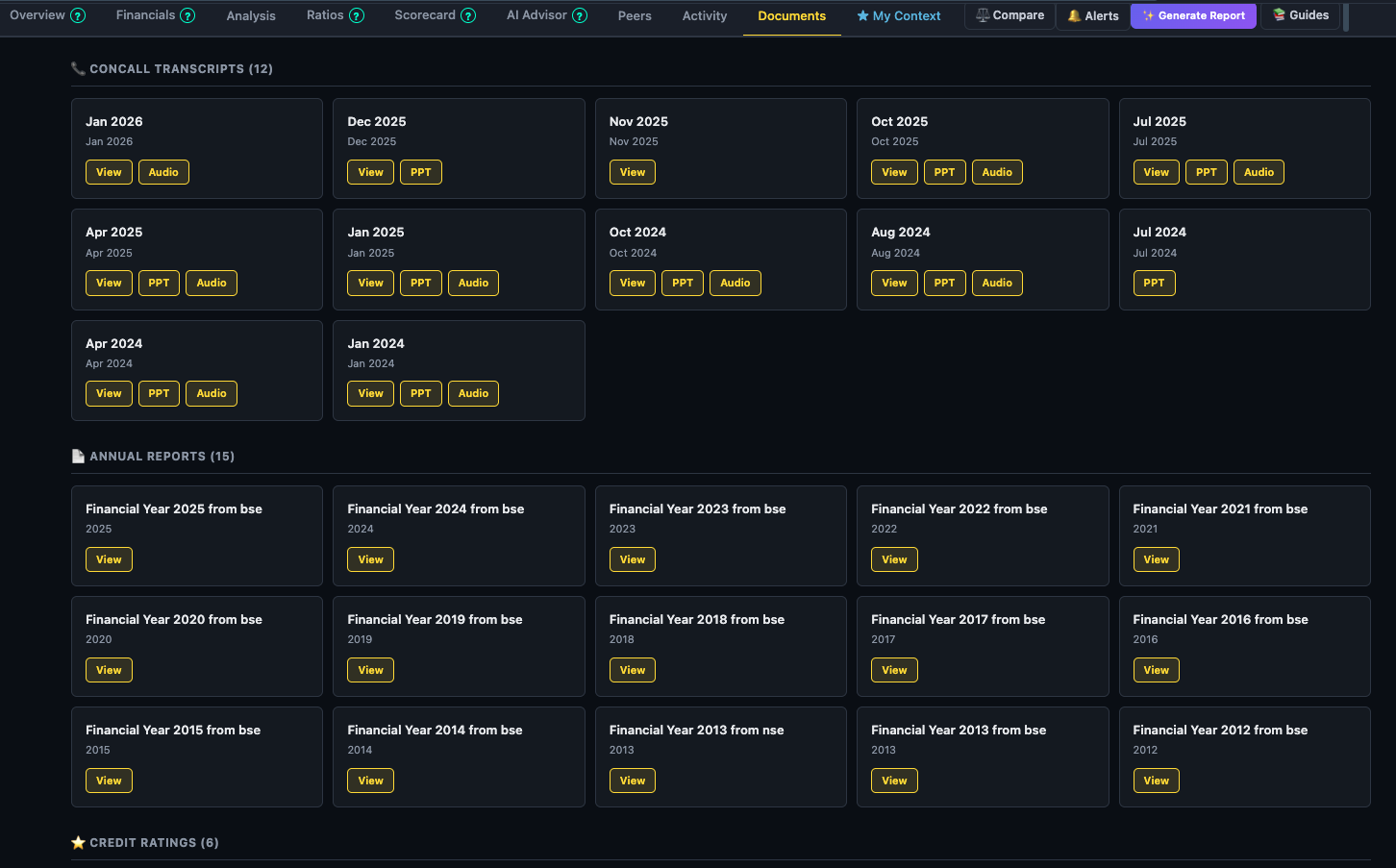
The Documents tab aggregates every primary source document for a company into a single, chronologically organised view. Instead of navigating the BSE website, hunting for PDFs across multiple pages, or searching for archived concall recordings, everything surfaces here automatically.
2. Concall Transcripts
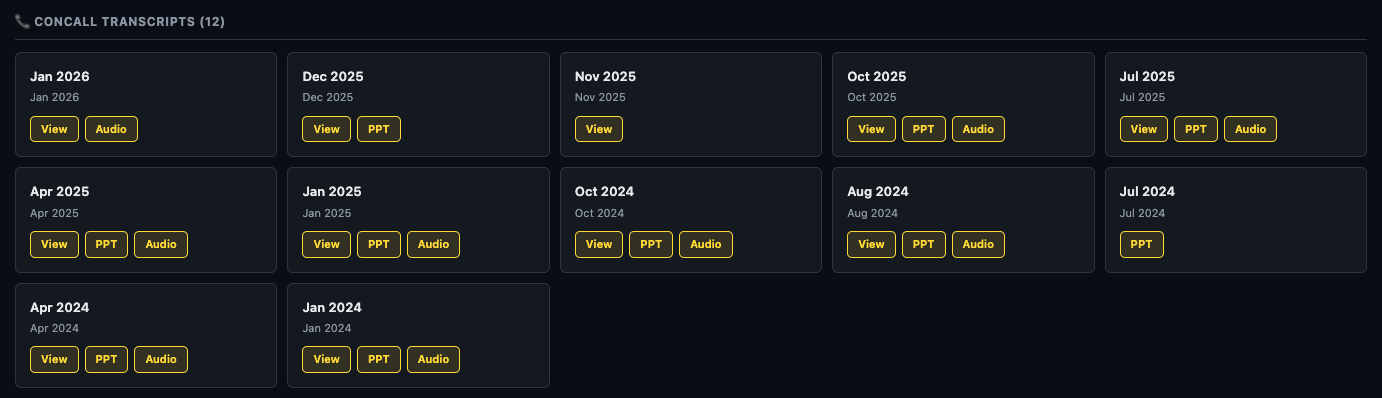
Earnings calls are where management speaks directly — guidance, risks, competitive commentary, and strategy. The Concall Transcripts section gives you up to 12 quarters of call records in reverse chronological order, so the most recent quarter is always at the top.
The three action buttons
- View — opens the full transcript of the call. Every question from analysts, every management response, every forward-looking statement is captured here. Available for most quarters.
- PPT — opens the management presentation slides. These contain information not always read aloud: strategic frameworks, segment-level guidance charts, capital allocation tables, and market share visuals. Available for quarters where management filed a presentation.
- Audio — opens the recording of the actual earnings call. Tone of voice, hesitations, and how management responds to pressure questions carry information that a transcript cannot capture. Available for quarters where the recording was archived.
What to look for in a concall
- Revenue guidance: Is management raising, maintaining, or cutting guidance? Any change in language around the word "confident" matters.
- Margin commentary: Are input cost pressures acknowledged? Is margin recovery being promised or hedged?
- Analyst pushback: The most revealing moments are when analysts push back and management deflects. Read those exchanges carefully.
- Deal wins and pipeline: For B2B or project-based businesses, new order announcements in concalls often precede revenue recognition by 1–3 quarters.
3. Annual Reports
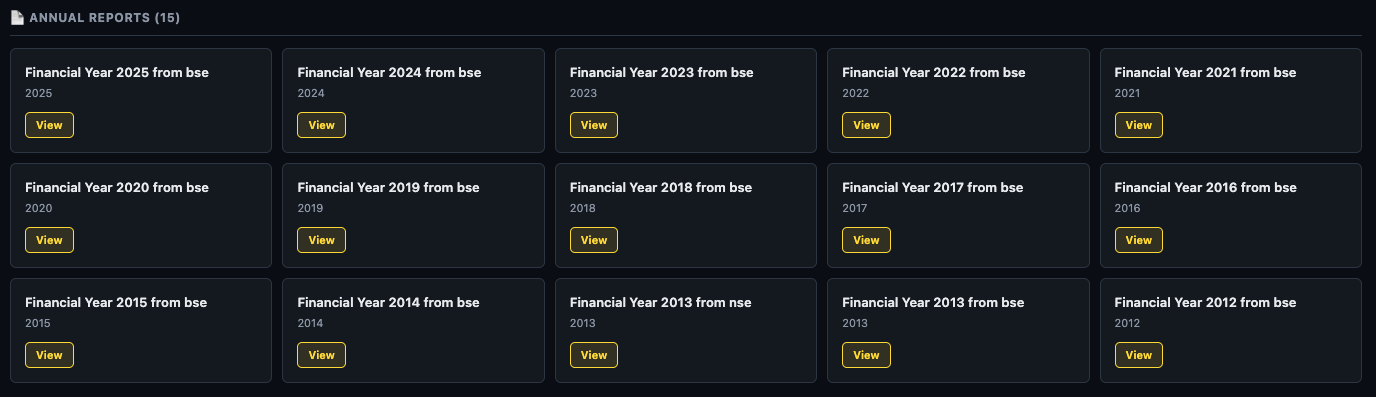
The Annual Report is the most complete picture of a company's year — financials, management discussion and analysis (MD&A), notes to accounts, auditor's report, corporate governance section, and the chairman's letter. Finmagine surfaces 12–15 years of reports so you can trace how the business has evolved over time.
Where to focus in an annual report
- MD&A (Management Discussion and Analysis): The business narrative — how management explains the year, risks they acknowledge, and the strategy going forward. This is where qualitative context lives.
- Notes to Accounts: The footnotes are where the details hide — contingent liabilities, related-party transactions, accounting policy changes, and off-balance-sheet exposures. Read the notes before trusting the headline numbers.
- Auditor's Report: Any "Emphasis of Matter" or "Key Audit Matter" flags are worth investigating. A clean opinion with unusual KAMs deserves attention.
- Chairman's / MD letter: Compare the letter from five years ago to today — does management deliver on what they promise? This is the fastest way to assess management credibility.
- Segment reporting: If the company has multiple divisions, segment revenue and margins reveal which businesses are actually profitable and which are cross-subsidised.
4. Credit Ratings
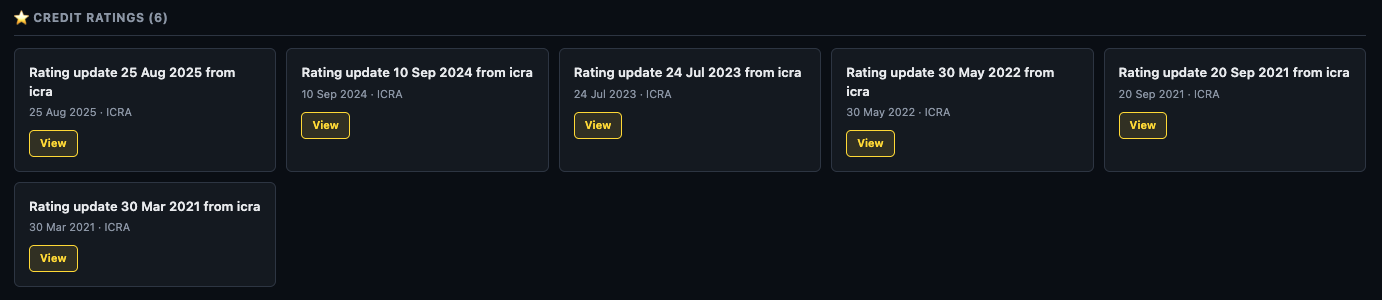
Credit rating updates are often overlooked by equity investors — but they should not be. Rating agencies like ICRA conduct independent financial analysis and publish their full rationale alongside the rating. This rationale frequently contains insights about debt serviceability, covenant headroom, and industry dynamics that equity research reports miss.
How to read a credit rating update
- Rating action: Is the rating being upgraded, maintained, or downgraded? A downgrade — even one notch — can signal that the agency has seen something in the financials that the market has not priced in yet.
- Outlook: Stable / Positive / Negative outlook. A "Negative" outlook on an otherwise good rating is a warning that a downgrade may follow in the next 12–18 months.
- Rationale highlights: The agency explicitly states what is driving the rating — revenue visibility, debt repayment schedule, working capital position, promoter support. These factors are directly addressable in the financials.
- Key rating sensitivities: What would cause a downgrade? If the agency says "significant deterioration in DSCR below 1.2x would trigger a review," you now know the exact threshold to monitor in financials.
5. Announcements
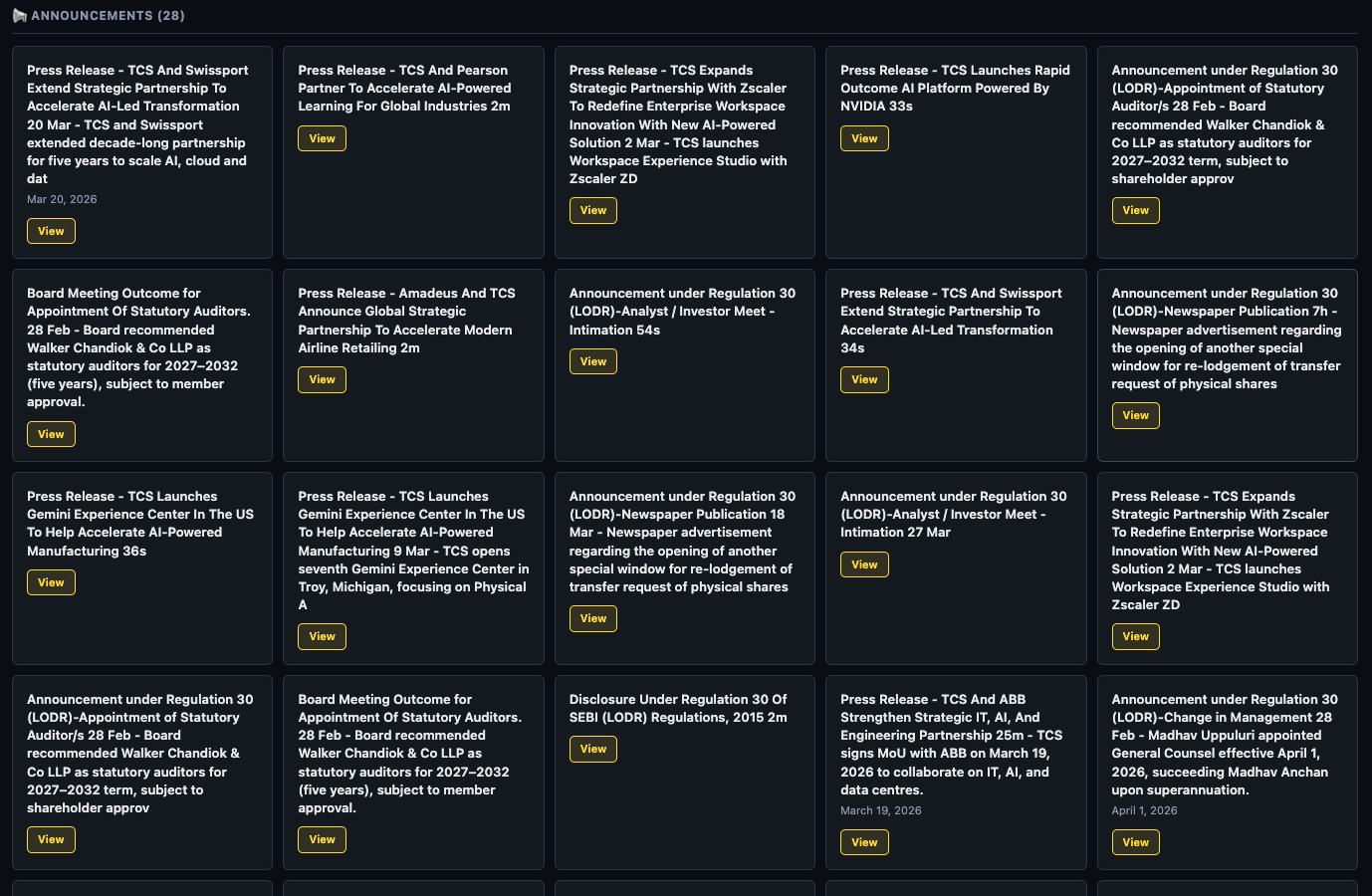
The Announcements section is the real-time regulatory and corporate news feed. Every disclosure the company files with BSE — from a major acquisition to a board member change to a press release about a new client partnership — appears here. For active research, this section keeps you current without needing to monitor BSE or news aggregators separately.
Types of announcements you will see
| Type | What it means | Why it matters |
|---|---|---|
| Press Releases | Company-initiated news — partnerships, new contracts, product launches, market expansions | Revenue pipeline signals. New client wins or large contract announcements often precede growth inflections. |
| Board Meeting Outcomes | Results of board meetings — dividend declarations, buyback approvals, capex sanctions, auditor appointments | Capital allocation decisions. A board-approved buyback signals management confidence; a capex sanction signals growth intent. |
| LODR Reg 30 (Intimations) | Material events required to be disclosed under SEBI's Listing Obligations — mergers, key personnel changes, litigation outcomes | Governance and risk signals. Key management personnel changes, especially at the CFO or CEO level, always warrant attention. |
| Analyst / Investor Meet | Notification that the company is meeting with analysts or institutional investors; sometimes includes the presentation used | If the company files the presentation, it is publicly available here — the same deck shown to institutional investors. |
| Newspaper Advertisements | Statutory notices — shareholder meeting notices, rights issue advertisements, record date intimations | Corporate action signals — upcoming dividends, rights issues, or special resolutions that affect shareholding. |
6. A Research Workflow Using All Four Document Types
Each document type serves a distinct research purpose. Used together, they give you the full picture that no single source provides alone:
- Step 1 Announcements — scan for material events. Start here to check whether anything significant has happened recently — a major contract win, a management change, a board decision. This sets the context before you read anything else.
- Step 2 Concall Transcripts (last 2 quarters) — read management's narrative. What did they say about growth, margins, and risks? Compare the two quarters to check consistency. Open the PPT alongside the transcript to see the slides that accompanied the call.
- Step 3 Annual Report (most recent year) — validate the narrative with the full financials. Cross-check the management's concall claims against the MD&A. Read the Notes to Accounts for anything the headline numbers obscure.
- Step 4 Credit Ratings (if the company carries debt) — read the rationale. Understand the agency's view on debt serviceability and what would trigger a rating change. This gives you the independent financial health check that management's own documents cannot provide.
7. Coverage Strip — See What's Missing, and Help Fill It In
Right at the top of the Documents tab, a row of pills shows at a glance which document types Finmagine actually has on file for this company — before you scroll down to look for yourself.
Submitting a missing document
- Next to any grey/missing pill, click submit (India) — on US, click submit next to the transcript pill any time, even with quarters already on file, to add one that's missing.
- A small form opens asking for a link to the document — a PDF, the BSE/NSE filing page, an investor-relations page, or a SEC filing page for US transcripts.
- Paste the link and click Submit. You'll see "Thanks — submitted for review" once it goes through.
The Research Agent shortcut
Above the coverage strip, a "🔬 Ask the Research Agent about SYMBOL →" link (Premium) jumps straight into the AI Research Agent, pre-scoped to this company and market, so you can ask a cited question grounded in exactly the documents this tab indexes without manually setting the scope yourself.
Ready to Analyse Indian Stocks Like a Pro?
Finmagine gives you 30+ computed financial ratios, sector benchmarks, FII/DII flows, the Finmagine Score, and AI-powered analysis — all in one place.